語意回憶
如果你問朋友上週末做了什麼,他會在記憶中搜尋與「上週末」相關的事件,再告訴你當時做了什麼。這大致就是 Mastra 語意回憶的運作方式。
觀看 Mastra 語意回憶,瞭解 Agent 如何擷取過往對話中的相關訊息。
語意回憶的運作方式「語意回憶的運作方式」的直接連結
語意回憶是一種以 RAG 為基礎的搜尋功能。當訊息已不在近期訊息歷史中時,它能協助 Agent 在較長的互動中維持脈絡。
它使用訊息的向量嵌入進行相似度搜尋、整合向量儲存,並可設定擷取訊息周圍的 context window。
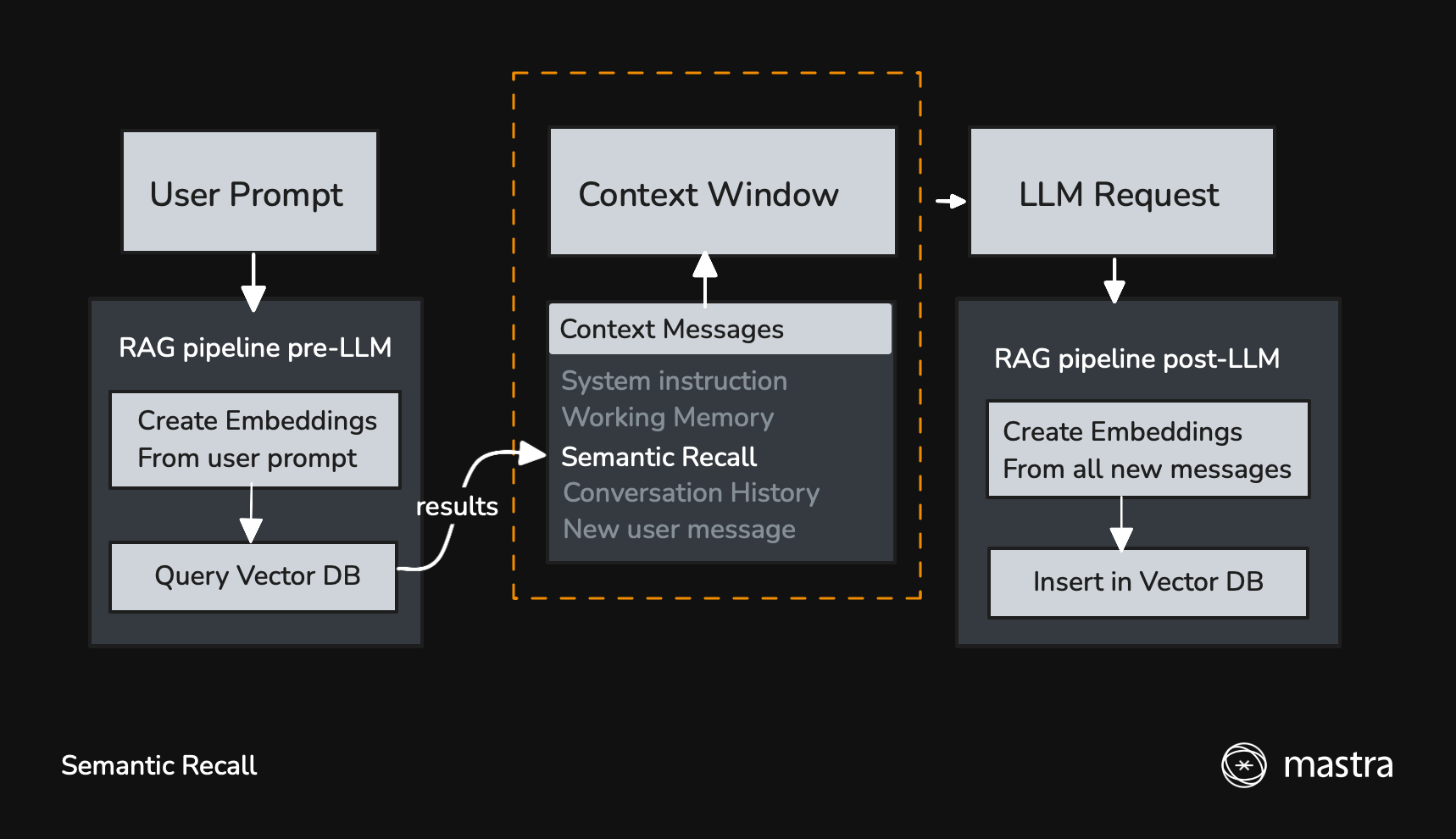
啟用後,新訊息會用來查詢向量資料庫,找出語意相似的訊息。
取得 LLM 回應後,所有新訊息(使用者、助理及 Tool 呼叫/結果)都會插入向量資料庫,以供後續互動回想。
快速開始「快速開始」的直接連結
語意回憶預設為停用。若要啟用,請在 options 中設定 semanticRecall: true,並提供 vector 儲存與 embedder:
- LibSQL
- MongoDB
import { Agent } from '@mastra/core/agent'
import { Memory } from '@mastra/memory'
import { LibSQLStore, LibSQLVector } from '@mastra/libsql'
import { ModelRouterEmbeddingModel } from '@mastra/core/llm'

const agent = new Agent({
  id: 'support-agent',
  name: 'SupportAgent',
  instructions: 'You are a helpful support agent.',
  model: 'openai/gpt-5.6-sol',
  memory: new Memory({
    storage: new LibSQLStore({
      id: 'agent-storage',
      url: 'file:./local.db',
    }),
    vector: new LibSQLVector({
      id: 'agent-vector',
      url: 'file:./local.db',
    }),
    embedder: new ModelRouterEmbeddingModel('openai/text-embedding-3-small'),
    options: {
      semanticRecall: true,
    },
  }),
})
import { Agent } from '@mastra/core/agent'
import { Memory } from '@mastra/memory'
import { MongoDBStore, MongoDBVector } from '@mastra/mongodb'
import { ModelRouterEmbeddingModel } from '@mastra/core/llm'

const agent = new Agent({
  id: 'support-agent',
  name: 'SupportAgent',
  instructions: 'You are a helpful support agent.',
  model: 'openai/gpt-5.6-sol',
  memory: new Memory({
    storage: new MongoDBStore({
      id: 'agent-storage',
      uri: process.env.MONGODB_URI,
      dbName: process.env.MONGODB_DB_NAME,
    }),
    vector: new MongoDBVector({
      id: 'agent-vector',
      uri: process.env.MONGODB_URI,
      dbName: process.env.MONGODB_DB_NAME,
    }),
    embedder: new ModelRouterEmbeddingModel('openai/text-embedding-3-small'),
    options: {
      semanticRecall: true,
    },
  }),
})
使用 recall() 方法「using-the-recall-method」的直接連結
listMessages 會依 thread ID 擷取訊息並提供基本分頁,而 recall() 另外支援語意搜尋。若需要依語意而非時間先後尋找訊息,請搭配 vectorSearchString 使用 recall():
const memory = await agent.getMemory()

// Basic recall - similar to listMessages
const { messages } = await memory!.recall({
  threadId: 'thread-123',
  perPage: 50,
})

// Semantic recall - find messages by meaning
const { messages: relevantMessages } = await memory!.recall({
  threadId: 'thread-123',
  vectorSearchString: 'What did we discuss about the project deadline?',
  threadConfig: {
    semanticRecall: true,
  },
})
儲存設定「儲存設定」的直接連結
語意回憶仰賴儲存空間與向量資料庫來儲存訊息及其嵌入向量。
import { Memory } from '@mastra/memory'
import { Agent } from '@mastra/core/agent'
import { LibSQLStore, LibSQLVector } from '@mastra/libsql'

const agent = new Agent({
  memory: new Memory({
    // this is the default storage db if omitted
    storage: new LibSQLStore({
      id: 'agent-storage',
      url: 'file:./local.db',
    }),
    // this is the default vector db if omitted
    vector: new LibSQLVector({
      id: 'agent-vector',
      url: 'file:./local.db',
    }),
    options: {
      semanticRecall: true,
    },
  }),
})
以下每個向量儲存頁面都包含安裝說明、設定參數與使用範例:
- Astra
- Chroma
- Cloudflare Vectorize
- Convex
- Couchbase
- DuckDB
- Elasticsearch
- LanceDB
- libSQL
- MongoDB
- OpenSearch
- OracleDB
- Pinecone
- PostgreSQL
- Qdrant
- S3 Vectors
- Turbopuffer
- Upstash
回憶設定「回憶設定」的直接連結
下列選項可控制語意回憶行為:
- topK:要擷取的相似訊息數量
- messageRange:每個相符項目周圍要一併納入的訊息
- scope:搜尋目前 thread,或某個 resource 的所有 thread
- filter:限制搜尋結果的 metadata 條件
const agent = new Agent({
  id: 'agent',
  memory: new Memory({
    options: {
      semanticRecall: {
        topK: 3, // Retrieve 3 similar messages
        messageRange: 2, // Include 2 messages before and after each match
        scope: 'resource', // Search all threads for this resource
        filter: { projectId: { $eq: 'project-a' } },
      },
    },
  }),
})
LibSQL、OracleDB、PostgreSQL、MongoDB 與 Upstash 儲存 adapter 支援 scope: 'resource'。
Metadata 篩選「Metadata 篩選」的直接連結
filter 選項會將語意回憶結果限制為 thread metadata 相符的訊息。
const agent = new Agent({
  id: 'agent',
  memory: new Memory({
    options: {
      semanticRecall: {
        scope: 'resource',
        filter: {
          projectId: { $eq: 'project-a' },
          category: { $in: ['work', 'personal'] },
        },
      },
    },
  }),
})
篩選條件會比對儲存訊息時寫入訊息嵌入向量的 metadata。若 thread metadata 日後變更,現有嵌入向量仍會保留先前的 metadata,直到再次儲存或建立這些訊息的索引。
支援的篩選運算子:
$and:邏輯 AND$eq:等於$gt:大於$gte:大於或等於$in:位於陣列中$lt:小於$lte:小於或等於$ne:不等於$nin:不在陣列中$or:邏輯 OR
以下範例示範常見使用情境的 metadata 篩選條件:
// Filter by project
const options = {
  semanticRecall: { filter: { projectId: { $eq: 'my-project' } } },
}

// Filter by multiple categories
const options = {
  semanticRecall: { filter: { category: { $in: ['work', 'research'] } } },
}

// Filter by project and priority
const options = {
  semanticRecall: {
    filter: {
      $and: [{ projectId: { $eq: 'project-a' } }, { priority: { $gte: 3 } }],
    },
  },
}
Embedder 設定「Embedder 設定」的直接連結
語意回憶仰賴嵌入模型將訊息轉換為嵌入向量。Mastra 可透過 model router 使用 provider/model 字串來支援嵌入模型,你也可以使用任何與 AI SDK 相容的嵌入模型。
使用 Model Router(建議)「使用 Model Router(建議)」的直接連結
最簡單的方式是使用支援自動完成的 provider/model 字串:
import { Memory } from '@mastra/memory'
import { Agent } from '@mastra/core/agent'
import { ModelRouterEmbeddingModel } from '@mastra/core/llm'

const agent = new Agent({
  id: 'agent',
  memory: new Memory({
    embedder: new ModelRouterEmbeddingModel('openai/text-embedding-3-small'),
    options: {
      semanticRecall: true,
    },
  }),
})
支援的嵌入模型:
- OpenAI:
text-embedding-3-small、text-embedding-3-large、text-embedding-ada-002 - Google:
gemini-embedding-001 - OpenRouter:存取各種 Provider 的嵌入模型
import { Agent } from '@mastra/core/agent'
import { Memory } from '@mastra/memory'
import { ModelRouterEmbeddingModel } from '@mastra/core/llm'

const agent = new Agent({
  id: 'agent',
  memory: new Memory({
    embedder: new ModelRouterEmbeddingModel({
      providerId: 'openrouter',
      modelId: 'openai/text-embedding-3-small',
    }),
  }),
})
Model router 會自動從環境變數(OPENAI_API_KEY、GOOGLE_API_KEY、OPENROUTER_API_KEY)偵測 API key。Google 模型也會改用 GOOGLE_GENERATIVE_AI_API_KEY 作為備援。
使用 AI SDK 套件「使用 AI SDK 套件」的直接連結
你也可以直接使用 AI SDK 嵌入模型:
import { Memory } from '@mastra/memory'
import { Agent } from '@mastra/core/agent'
import { ModelRouterEmbeddingModel } from '@mastra/core/llm'

const agent = new Agent({
  id: 'agent',
  memory: new Memory({
    embedder: new ModelRouterEmbeddingModel('openai/text-embedding-3-small'),
  }),
})
使用 FastEmbed(本機)「使用 FastEmbed(本機)」的直接連結
若要使用 FastEmbed(本機嵌入模型),請安裝 @mastra/fastembed:
- npm
- pnpm
- Yarn
- Bun
npm install @mastra/fastembed@latest
pnpm add @mastra/fastembed@latest
yarn add @mastra/fastembed@latest
bun add @mastra/fastembed@latest
接著在 Memory 中進行設定:
import { Memory } from '@mastra/memory'
import { Agent } from '@mastra/core/agent'
import { fastembed } from '@mastra/fastembed'

const agent = new Agent({
  id: 'agent',
  memory: new Memory({
    embedder: fastembed,
  }),
})
PostgreSQL 索引最佳化「PostgreSQL 索引最佳化」的直接連結
使用 PostgreSQL 作為向量儲存時,可以設定向量索引來最佳化語意回憶效能。對於包含數千則訊息的大規模部署,這點尤其重要。
PostgreSQL 同時支援 IVFFlat 與 HNSW 索引。Mastra 預設會建立 IVFFlat 索引,但 HNSW 索引通常能提供更好的效能,尤其是使用內積距離的 OpenAI 嵌入向量。
import { Memory } from '@mastra/memory'
import { PgStore, PgVector } from '@mastra/pg'

const agent = new Agent({
  memory: new Memory({
    storage: new PgStore({
      id: 'agent-storage',
      connectionString: process.env.DATABASE_URL,
    }),
    vector: new PgVector({
      id: 'agent-vector',
      connectionString: process.env.DATABASE_URL,
    }),
    options: {
      semanticRecall: {
        topK: 5,
        messageRange: 2,
        indexConfig: {
          type: 'hnsw', // Use HNSW for better performance
          metric: 'dotproduct', // Best for OpenAI embeddings
          m: 16, // Number of bi-directional links (default: 16)
          efConstruction: 64, // Size of candidate list during construction (default: 64)
        },
      },
    },
  }),
})
如需索引設定選項與效能調校的詳細資訊,請參閱 PgVector 設定指南。
停用語意回憶「停用語意回憶」的直接連結
語意回憶預設為停用(semanticRecall: false)。每次呼叫都會增加延遲,因為新訊息會先轉換成嵌入向量並用於查詢向量資料庫,之後 LLM 才會收到訊息。
在下列情況下,請維持停用語意回憶:
- 訊息歷史已為目前對話提供足夠的脈絡。
- 你正在建置對效能敏感的應用程式,例如即時雙向音訊,其中嵌入與向量查詢延遲會明顯影響體驗。
查看回想出的訊息「查看回想出的訊息」的直接連結
啟用 Tracing 後,任何透過語意回憶擷取的訊息都會與近期訊息歷史(若有設定)一併顯示在 Agent 的 Trace 輸出中。